
V1 started as a list of features on a PRD. It ended with five AI agents cross-examining the code, arguing about Breggle armour class, and discovering an export function that had been silently querying a table that doesn’t exist.
This post covers everything since Dev Log #5: a nine-feature sprint, four final gap-fillers, a multi-agent review pipeline, and the fixes that came out of it.
The Final Sprint: Nine Features in One PR
PR #9 landed nine of the original PRD features. Here’s what shipped:
Forgot Password — the flow most apps ship first and we shipped last. Email → reset link → /reset-password → new password via supabase.auth.updateUser(). Works.
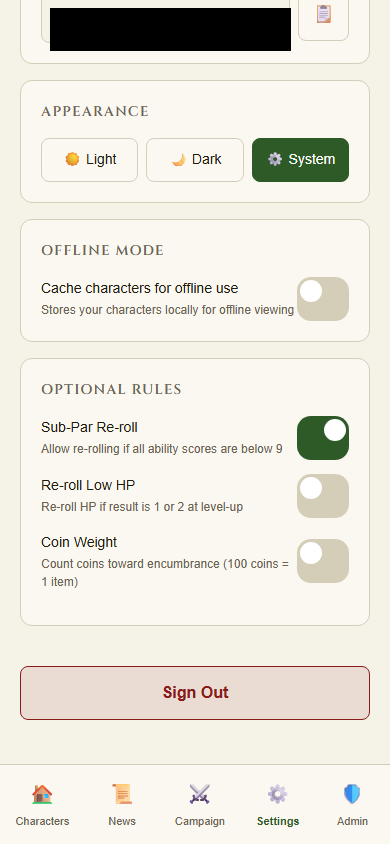
Optional Rules Settings — three house rule toggles stored in localStorage:
- Sub-par re-roll (all scores ≤ 9 → re-roll banner in wizard)
- Re-roll low HP (1s and 2s on HP at level-up)
- Coin weight counts toward encumbrance
These are exposed via a useOptionalRules() hook so any component can read them without prop-drilling through half the character sheet.
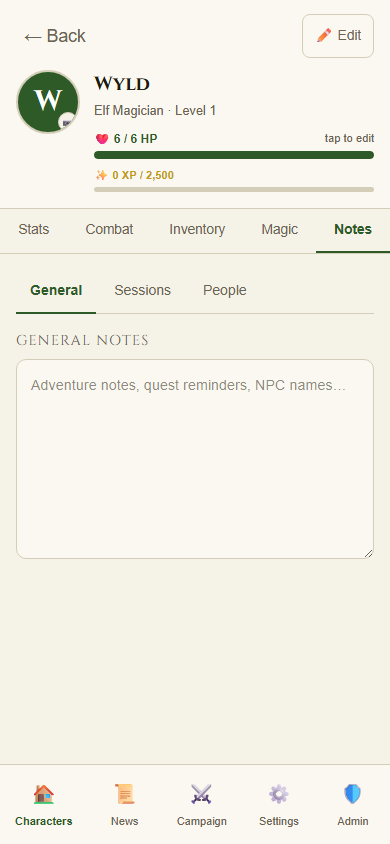
Session Notes and People of Note — the Notes tab grew up. It now has three sub-tabs: General (the original textarea), Sessions (timestamped entries, one per session), and People (name + brief note pairs). Both new sections store as JSONB in the characters table.
Promote Retainer to PC — a retainer that survives long enough to become a full character can be promoted. The UI creates a proper character row from the retainer’s data and sets is_promoted_to_pc = true to hide the retainer card. No data is lost.
Ammo Counter and Battle View — ranged weapons now show ammo count. “Start Battle” opens a modal with a large “Shot Fired” button that decrements quantity. Ending battle rolls for recovery (d6, recover half rounded down per Dolmenwood rules) and adds arrows back automatically.
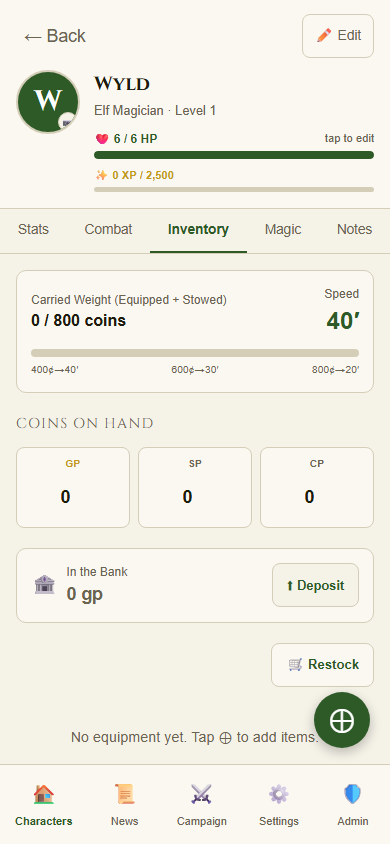
Restock Tool — a bottom sheet on the Inventory tab with pre-defined consumables (arrows, torches, rations, oil, animal feed) and a running total vs. GP available. Confirmation auto-decrements gold.
Portrait Upload — tap the avatar in the character sheet header → file picker → uploads to Supabase Storage at portraits/{character_id} → public URL saved to characters.portrait_url. Kindred emoji fallback if null.
Mount Management — a mounts table with full stat block support. Knight warhorses get AC, HP, attack, saves, and morale. Other mounts show speed only. Character sheet has a collapsible Mounts section in the Combat tab.
Read-Only Referee View — referees can tap any party member’s character card and get a full character sheet in read-only mode. No edit buttons, no HP adjusters. RLS policy added for SELECT access scoped to campaigns the referee manages.
Infrastructure: The Build That Kept Breaking
Shipping nine features also meant fixing the deployment pipeline twice.
AcrPull scope conflict — changing the scope of an Azure role assignment breaks ARM. The pipeline started throwing RoleAssignmentUpdateNotPermitted because we’d tried to tighten the AcrPull assignment from resource-group level to ACR level. ARM saw the same GUID pointing at a different scope and rejected it. The fix was reverting to resource-group scope and documenting why in the codebase so no future agent flags it as a finding.
Key Vault immutability — softDeleteRetentionInDays cannot be changed after vault creation. ARM returns BadRequest: The property has been set already and it can't be modified. Documented and accepted; changing it requires destroying the vault and losing all secrets.
CI path filters — deploy workflows now skip when only documentation or config files change. No more production deploys triggered by a README edit.
Closing the Gaps: Four More Features
After PR #9 merged, I ran a gap analysis against the original PRD. Most of it was done. Four things remained:
Languages — each kindred speaks specific native languages. INT modifier grants bonus language slots (one per +1 above neutral). The getKindredLanguages() function was already in the rules engine; it just wasn’t wired into the character sheet. A new extra_languages JSONB column on characters stores learned languages. In edit mode, players can add and remove custom languages.
Level Up Log — every time a character levels up, the level_up_logs table records from_level, to_level, hp_roll, hp_roll_final, and a changes JSONB diff. There was no UI for it. A new page at /characters/[id]/level-up-log shows a timeline of all level-up events, newest first, accessible from a ⋮ menu in the character sheet header.
Export Characters as JSON — a “Data” section in Settings with a button that fetches all characters, inventory, spell slots, and preparations for the current user and triggers a browser download of a JSON file. No backend needed — client-side Supabase query + blob URL.
Delete Account — a “Danger Zone” section in Settings. Clicking the button opens a modal that requires typing DELETE before proceeding. On confirm, a delete_my_account() SECURITY DEFINER RPC deletes the user from auth.users, which cascades to all their data. Session cleared, redirect to sign-in.
The Five-Agent Review Pipeline
With all features implemented, I ran five specialized review agents against the PR simultaneously. Each is a separate GitHub Copilot Agent session with a role-specific system prompt — code reviewer, security auditor, DevOps engineer, QA engineer, and architect — all running concurrently against the same branch. Running them in parallel takes the same wall-clock time as running one, and each brings a completely different mental model to the same code.
| Agent | Focus |
|---|---|
| Code Reviewer | Data flow, error handling, correctness |
| Security Reviewer | RLS, SECURITY DEFINER, auth guards, open redirects |
| DevOps Reviewer | Docker, CI pipeline, Bicep IaC, deployment correctness |
| QA Reviewer | Test coverage, game rules correctness, edge cases |
| Developer Architect | Conventions, type system, state management patterns |

Each agent delivers findings independently — no cross-contamination. I then triage, fix, and commit in a single pass.
Twelve Bugs That Mattered
Here are the findings that would have made it to production:
Wrong table name (critical) — The level-up log page queried level_up_log. The actual table is level_up_logs. Supabase RLS silently returns an empty result for queries against non-existent table names rather than raising an error. Every character would show an empty timeline with no indication that anything was wrong.
Wrong column name (critical) — The same page sorted by created_at. The actual timestamp column is called timestamp. Silent failure — no ordering, no dates displayed.
Export pointed at a ghost table (critical) — The export function fetched from character_spells. That table does not exist. The actual spell data lives in spell_slots and spell_preparations. Every export attempt would silently produce an empty array. Fixed to join spell_slots() and spell_preparations().
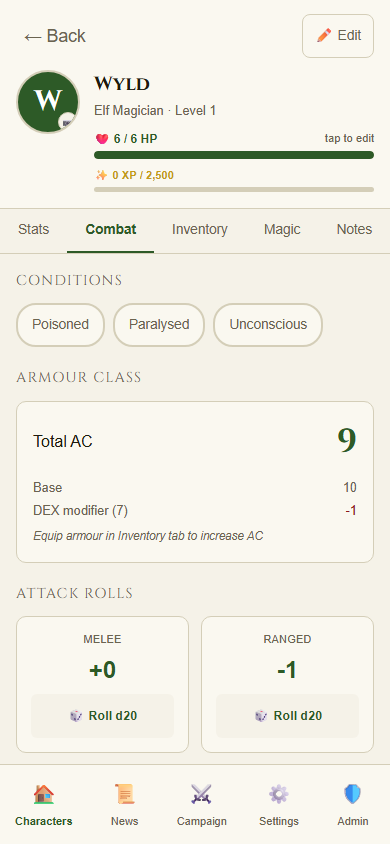
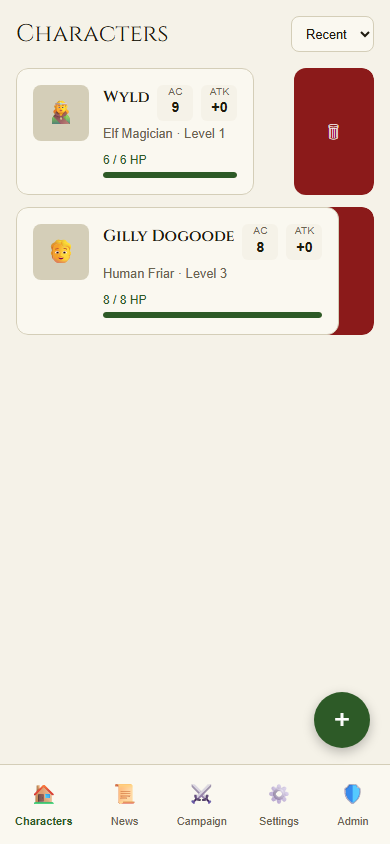
Breggle AC wrong since day one (high) — Breggle kindred gets a +1 AC bonus. The rules engine has getKindredACBonus(). The character sheet called calculateAC() with kindredACBonus: 0 hardcoded. Every Breggle character in the game had been displaying AC one point too high — for weeks, across every session, for every character with that kindred. Fixed by importing and calling getKindredACBonus(character.kindred).
delete_my_account missing auth guard (security) — The SECURITY DEFINER RPC had no check for auth.uid() IS NULL. A call without a valid session (direct SQL or race condition) would have allowed deletion of arbitrary accounts. Fixed with RAISE EXCEPTION guard.
search_path injection vector (security) — The same RPC used SET search_path = public. SECURITY DEFINER functions should use SET search_path = '' and qualify all references explicitly. Fixed.
URL.revokeObjectURL called before download (medium) — The export function revoked the blob URL immediately after calling click(). Browser downloads are async; the file could be released before it finished transferring. Fixed with a 1-second delay.
Dockerfile public/ missing –chown (devops) — The COPY public/ ./public/ step in the Dockerfile was missing --chown=nextjs:nodejs. Static assets were owned by root inside the container.
Language limit not enforced (medium) — Players could add unlimited custom languages regardless of INT modifier slots. Frontend-only validation added with rollback on Supabase error.
Unsafe params.id cast (medium) — The level-up log page did params.id as string. Next.js 15 params are Promise<{ id: string }> — the cast was correct syntax but the extraction was wrong. Fixed to use proper async param destructuring.
Typed DELETE confirmation not working — The delete account modal had a text comparison bug where the confirm button would enable incorrectly. Fixed the deleteConfirmText state comparison.
Error handling missing in three places — addLanguage, removeLanguage, and handleExportData had no error handling. Any Supabase error would fail silently or leave the UI in a broken state.
What’s Next
V1 is merged. The five-agent review caught what I would have missed. The prod app has thirteen features that work correctly, a migration stack that’s solid, and a CI pipeline that doesn’t deploy when you fix a typo in the docs.
First: PR #10 merges, and then we actually play the game.
The PRD has a v2 section — campaign-level features, dice roller integration, more referee tools. That’s a problem for next sprint.
Dolmenwood Beyond is a personal project. The game itself is by Gavin Norman / Necrotic Gnome.
 DevOps Reverse Engineer
Leave a comment